Mouraria and the Tagus in one easy plan. This 4-hour small-group walk mixes neighborhood history, quick tastes of Lisbon, and a real ferry ride that sets you up for the rest of your trip. I love how it takes you off the main tourist circuit, with stops that feel like you’re with a local rather than following a checklist.
Two things I really like: you get practical food breaks built into the route (coffee/pastries, a beer stop, then lunch), and the guide steers you through places you’d miss trying to DIY. It’s also the kind of tour where the pacing feels relaxed, even with plenty of walking.
One consideration: the tour includes traditional venues, and while vegetarian and gluten-free options may exist, they’re not guaranteed on all stops—and it is not suitable for celiacs, vegans, Kosher, or Halal. If you’re traveling with serious allergies, plan carefully.
In This Review
- Key things I’d highlight before you go
- Why this Lisbon walk feels different from the usual route
- Starting in Praça Martim Moniz: multicultural streets and your first snack
- Mouraria’s Moorish Quarter and the Fado connection you’ll actually remember
- Rossio Square and Chiado pass-through: architecture and local meeting points
- Views at Carmo Convent area: beer in hand, Lisbon laid out below
- The ferry to Cacilhas: Lisbon’s river views without the long day
- Pace and group size: what that means for your day
- Food and drink: what’s included, and what you should double-check
- Price and value: why $48.39 can make sense in Lisbon
- Should you book this Lisbon traditions-and-ferry walk?
- FAQ
- How long is the tour?
- Where do I meet the guide, and where does the tour end?
- What time does the tour start?
- Is this tour a small group?
- What’s included in the price?
- Are vegetarian or gluten-free options available?
- Does the tour include the Santa Justa Lift?
- Can I get a full refund if I cancel?
- Is it suitable for people with limited mobility?
Key things I’d highlight before you go
- A small group (max 14) keeps the tour personal and makes questions easy.
- Mouraria + Fado stories give you cultural context before you see the rest of Lisbon.
- Coffee/pastries, beer, and a full lunch mean fewer “what now?” moments.
- Ferry to Cacilhas adds a postcard view without turning the day into a long outing.
- Rossio and the neo-Manueline station details show you Lisbon architecture in a practical walk.
- Traditional food stops can be tough for some diets, so check your needs early.
Why this Lisbon walk feels different from the usual route
Lisbon is famous for viewpoints and trams, but the city also runs on daily life: neighbors, small bakeries, family-run restaurants, and music you hear from doorways. This tour threads that daily life into a walk that stays mostly on foot, including areas where cars can’t really push through.
What makes it work is the mix of story + food + river time. You’ll learn the why behind neighborhoods like Mouraria, then you’ll eat and drink in the middle of it. And when you cross the Tagus, the views don’t feel like a detour—they feel like the point.
There’s also a very practical feel to it. The route is designed to help you get your bearings fast: where you are in the city, how neighborhoods connect, and what to come back for later (including tips for dinners and Fado nights, depending on your guide).
Starting in Praça Martim Moniz: multicultural streets and your first snack
You meet at Praça Martim Moniz (meeting point address: Praça Martim Moniz 2) in the historic district of Mouraria. This area matters because it’s one of Lisbon’s most multicultural corners. If you arrive early, you’ll notice the weekend energy: a market for biological products, plus shops, music, and shows.
The tour’s first stop feels like a gentle landing. You get your coffee and pastries, then your guide starts setting the theme: how Portugal’s history (including the seafaring era) helped shape the mix of cultures you see today. It’s not just “look at this street.” It’s why this neighborhood became what it is.
If you like tours that don’t start with a lecture, you’ll probably enjoy this one. It starts with motion and flavor, then turns the history dial up gradually.
Mouraria’s Moorish Quarter and the Fado connection you’ll actually remember

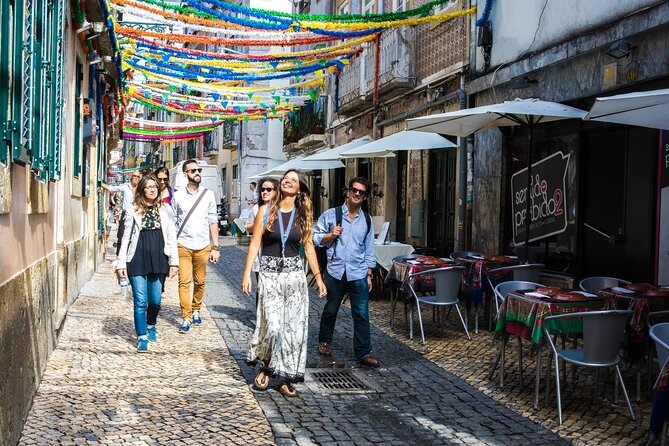
From Martim Moniz, you head into the Moorish Quarter, a neighborhood that’s often passed over if you only chase postcards. Here, you’ll walk narrow streets with small churches and traditional shops, guided by the idea that Mouraria was historically tied to the Moors and became a longtime residential district.
This is where the tour gets more cultural than “sightseeing.” You’ll hear how Portugal’s discoveries and maritime history fed outside influences into Lisbon life. Then you get introduced to Fado, which is listed by UNESCO as Intangible Cultural Heritage—so the music isn’t treated as a gimmick for tourists.
One story that helps it click is the mention of Maria Severa, an important figure tied to the Fado story. Even if you’ve never heard Fado before, you’ll leave with a sense that it’s personal, historical, and rooted in place.
Practical tip: wear shoes with real grip. The streets here are typically old and uneven, and the tour keeps moving. It’s leisurely, but it’s still walking.
Rossio Square and Chiado pass-through: architecture and local meeting points

Next you pass toward Rossio, with a stop that includes the feel of the old downtown core. Your guide points out the neo-Manueline façade as you walk near the Rossio train station. That detail matters because it shows you how Lisbon’s style changes over time—how “new” Lisbon still wears historical flair.
Then you reach Rossio Square (Praça de D. Pedro IV), a 19th-century public space known for its classic cobblestones. This square has seen everything from public celebrations to darker episodes like executions and revolts, which is a reminder that squares aren’t just pretty. They’re where history happened.
From there, you also pass through the area called Chiado, which is known for its cultural and commercial life—shops, theaters, and museums. You don’t need to spend hours here on this tour, but walking through gives you a useful mental map for where to aim later.
If your goal is to understand Lisbon as locals experience it—meeting places, routes, neighborhoods—you’ll like this segment. It’s short, but it’s functional.
Views at Carmo Convent area: beer in hand, Lisbon laid out below
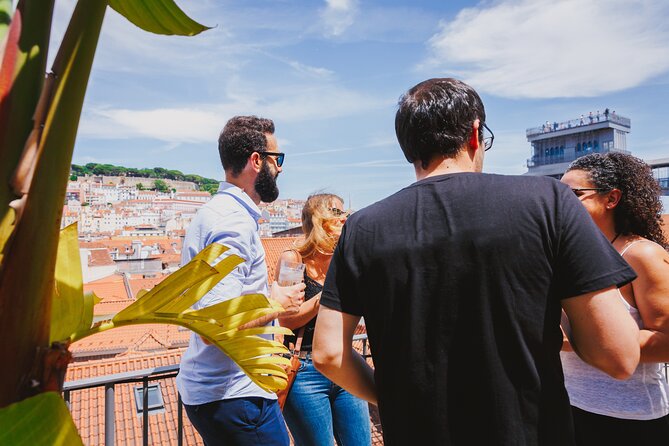
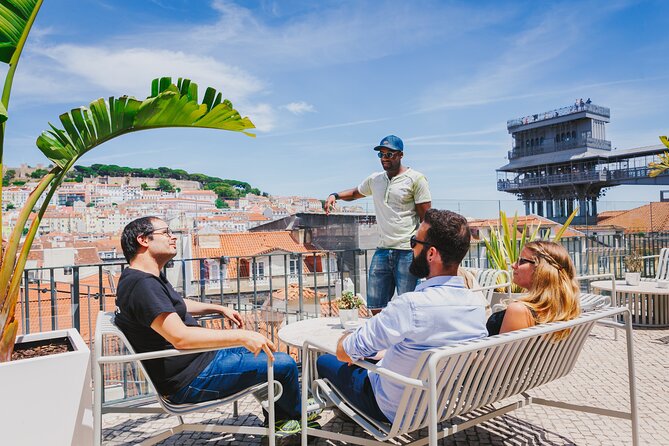
One of the most rewarding stretches is the climb toward the Carmo Convent viewpoint area. This stop is designed for that “oh wow” moment: you look out over Lisbon with sightlines that include major landmarks like São Jorge Castle and the Santa Justa Lift.
The tour pairs the viewpoint with a refreshing Portuguese beer, which is a smart move. You get a built-in reset before the day shifts toward the river.
A small note: the tour does not include entry on monuments, and it also doesn’t include a trip on the Santa Justa Lift itself. Still, seeing the Lift from this perspective helps you understand why it’s such a visual icon and where it sits in the city’s geometry.
The ferry to Cacilhas: Lisbon’s river views without the long day
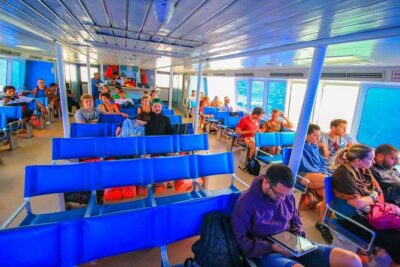
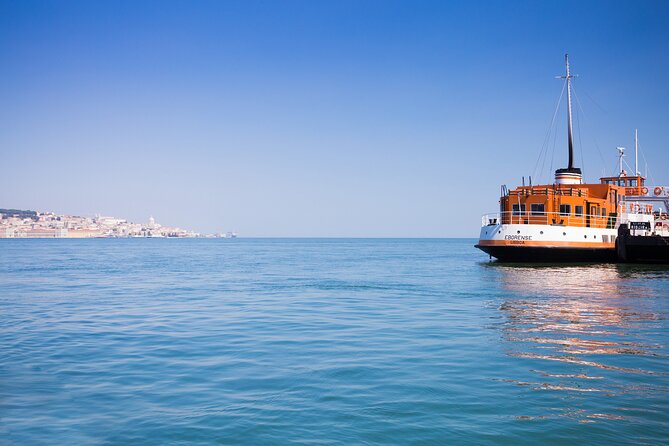
After you’ve done the hill-and-square segments, you move to the Tagus River. You board a ferry and cross to Cacilhas, taking in river views that are simply hard to match from inland streets. This is the part that turns the tour from “walking history” into “Lisbon in motion.”
On the other side, you spend time at Pontal de Cacilhas, which is full of seafood restaurants. It’s one of those areas that feels practical rather than theatrical—exactly what you want when the goal is to eat like locals, not like a showroom.
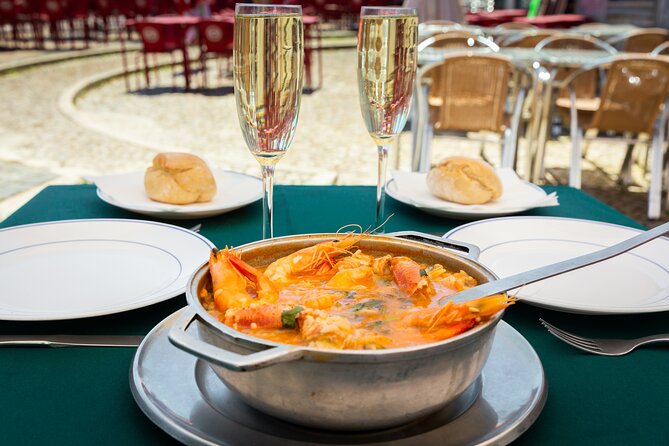
Then the tour sets you up for the main lunch: you go to a riverside restaurant for famous seafood rice, paired with green wine and bread. You’ll have a panoramic view while you eat, and the river crossing makes the meal feel like part of the same story.
If you want to keep your afternoon flexible afterward, this is also a nice rhythm. Lunch isn’t the end; it’s a checkpoint. When you’re done, you can keep exploring on your own with clearer bearings.
Pace and group size: what that means for your day

This experience runs about 4 hours. That length is long enough to cover meaningful neighborhood ground and still include multiple food stops, but short enough that it doesn’t bully your whole day.
The small-group size—max 14 travelers—is a real advantage. It makes the tour easier to follow, and you’re less likely to be stuck behind a crowd during viewpoint moments or snack lines. Many guides featured in this tour’s history (names you might hear like Maria, Franco, Carlos, Filipe, Guilherme, Daniel, Chon, Alex, Martin, Leslie, Johnny, Natália, and Philla) are praised for being friendly and for keeping the pace workable, not frantic.
Practical footwear matters. You’ll be walking at a steady rhythm through older streets. If you do okay with uneven sidewalks and some uphill-to-viewpoint segments, you’ll likely feel comfortable.
Food and drink: what’s included, and what you should double-check
This tour treats food like part of the itinerary, not a reward at the end. Included stops are:
- Coffee and pastries
- Lunch: seafood rice, plus green wine and bread
- Beer
- Ferry-boat ride
That’s good value because you’re not paying separately for a snack, a drink, and a full meal during a busy day.
Now the important part: dietary limits. The tour says that vegetarian and gluten-free options are available but not guaranteed on all stops. And it also explicitly states the experience is not suitable for celiacs, vegans, Kosher, and Halal.
So here’s the honest way to plan:
- If you’re only “prefer” vegetarian or gluten-light, this might work.
- If you have a serious allergy (especially gluten for celiacs), don’t assume substitutes exist.
- If you’re vegan or follow Kosher/Halal, this is a no-go based on the tour’s stated limits.
Price and value: why $48.39 can make sense in Lisbon
At $48.39 per person for about 4 hours, the price looks reasonable when you break it down. You’re getting:
- two meal-style stops (coffee/pastry + lunch),
- an alcoholic drink break (beer),
- a ferry crossing,
- and a local guide to connect the dots between neighborhoods, Fado, and Lisbon’s historical layers.
The tour also goes where cars don’t really go—meaning you’re using walking routes that help you reach areas with small streets and local storefronts. That’s hard to replicate quickly on your own, especially on a first trip.
Where value can drop is exactly where you’d expect: if your dietary needs don’t match what the tour can provide, you may have to think about alternatives on the spot. But if your needs are flexible within the stated limits, the package is a strong deal for an organized intro to the city.
Should you book this Lisbon traditions-and-ferry walk?
I’d book it if you want a first-day-friendly plan that mixes culture with practical food and a real river crossing. It’s especially a good fit if you like walking through neighborhoods like Mouraria, learning why they matter, and getting a sense of Lisbon’s rhythm rather than just collecting monuments.
I’d skip it if you need strict dietary accommodations like celiac-level gluten safety, vegan meals, or Kosher/Halal food. In that case, you’ll spend energy solving food issues instead of enjoying the walk.
Bottom line: this is the kind of tour that helps you start Lisbon with context and end it with a full stomach and better bearings for the rest of your trip.
FAQ
How long is the tour?
The tour lasts about 4 hours.
Where do I meet the guide, and where does the tour end?
You meet at Praça Martim Moniz 2, 1100-341 Lisboa, Portugal, and the tour ends at Cais do Sodré, Lisboa.
What time does the tour start?
The start time is 10:00 am.
Is this tour a small group?
Yes. The tour has a maximum of 14 travelers.
What’s included in the price?
Coffee and pastries, lunch (seafood rice, green wine, and bread), a beer stop, a ferry-boat ride, and a local guide.
Are vegetarian or gluten-free options available?
Vegetarian and gluten-free options are available, but they are not guaranteed at all stops.
Does the tour include the Santa Justa Lift?
No. The tour does not include a trip on Santa Justa Lift.
Can I get a full refund if I cancel?
Yes. You can cancel up to 24 hours in advance for a full refund.
Is it suitable for people with limited mobility?
The tour is listed as requiring moderate physical fitness, so plan for walking on uneven streets and steps.